


Key Takeaways
- Every PHV driver must hold a valid Private Hire Car Driver’s Vocational Licence (PDVL) issued by the Land Transport Authority before accepting passengers.
- Meeting PHV car requirements in Singapore involves proper vehicle classification, age limits, inspections, and emissions compliance.
- Only LTA-approved PHV vehicles that are registered under the correct scheme (Z10 or Z11) can operate legally.
- Standard motor insurance is insufficient. Dedicated PHV insurance in Singapore with commercial and passenger liability coverage is mandatory.
- Platform registration is separate from regulatory compliance. Drivers remain responsible for maintaining licence validity, inspections, and insurance at all times.
What Every PHV Driver Must Know Before Starting
Becoming a private-hire vehicle driver in Singapore involves more than simply owning a car and signing up with a ride-hailing platform. A prospective driver must satisfy licensing standards, ensure the vehicle complies with regulatory requirements, and maintain the correct insurance coverage before legally transporting passengers.
This guide explains the full framework, including what is mandatory under LTA regulations, what varies by platform, and where common misconceptions arise.
Understanding the PHV Driver Licence Requirement (PDVL)
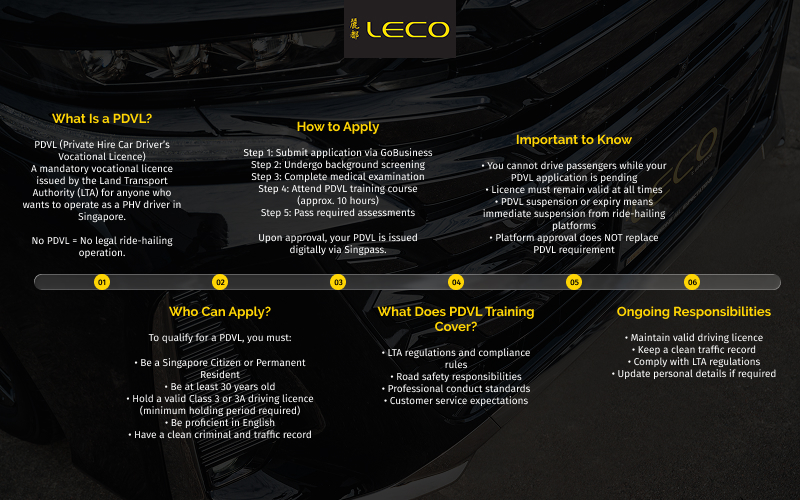
All private-hire drivers in Singapore must hold a Private Hire Car Driver’s Vocational Licence (PDVL) issued by the Land Transport Authority (LTA). This ensures baseline standards for road safety, local route familiarity, and professional conduct.
Basic Eligibility
To qualify for a PDVL, applicants must:
- Be a Singapore Citizen or Permanent Resident
- Be at least 30 years old
- Hold a valid Class 3 or 3A driving licence for the required minimum period
- Be proficient in English
Application Process
The PDVL application is submitted via the GoBusiness portal. The process also includes:
- Background screening conducted by the Singapore Police Force
- A medical examination at an approved clinic
- Mandatory training and assessment
The training course typically spans around 10 hours and covers regulatory responsibilities, safety protocols, and service standards. Upon passing the required assessments, the licence is issued digitally and accessible via Singpass.
Register for the training course by approved providers like ComfortDelgro and NTUC LearningHub.
Operating without a valid PDVL is an offence. No ride-hailing platform approval can substitute this requirement.
PHV Car Requirements in Singapore: What Your Vehicle Must Meet
Holding a PDVL alone is not sufficient. A PHV driver must also ensure the vehicle complies with national regulatory standards.
Vehicle Scheme Conversion
Vehicles must be converted to the correct scheme classification under LTA regulations:
- Z10 (Chauffeured Private Hire Car)
- Z11 (Private Hire Car)
This conversion is completed via the OneMotoring platform and formally registers the vehicle for commercial passenger use.
LTA Approved PHV Vehicles
Not every car model qualifies automatically. LTA-approved PHV vehicles must meet specific requirements, including:
- Vehicle age limits
- Emissions standards
- Roadworthiness inspections
- Compliance with safety regulations
Regular inspections are mandatory, and unauthorised modifications affecting safety or emissions can lead to disqualification.
Drivers sourcing vehicles through a parallel importer should confirm compliance before purchase, as import specifications must meet LTA requirements.
Choosing the Right Vehicle for PHV Driving
While regulatory approval is essential, practicality also matters. A driver must consider passenger comfort, fuel efficiency, maintenance cost, and demand patterns.
Popular choices often include compact crossovers such as those offered by a Toyota Sienta dealer in Singapore, which balance fuel efficiency and cabin space.
For premium or larger-capacity services, MPVs such as the Toyota Alphard are commonly deployed due to their spacious interiors and appeal to family or executive riders.
Platform preferences may vary, but LTA classification and compliance always take precedence.
PHV Insurance in Singapore: Why Private Insurance Is Not Enough
Insurance is one of the most misunderstood aspects of PHV operations.
Standard private motor insurance policies do not cover commercial passenger use. A PHV driver must obtain dedicated PHV insurance in Singapore that includes:
- Commercial usage coverage
- Passenger liability protection
- Third-party liability
Premiums are typically higher than private car insurance due to increased mileage and risk exposure. Coverage must remain valid at all times when the vehicle is being used for ride-hailing.
Failure to maintain appropriate insurance can result in serious penalties and invalid claims in the event of an accident.
Platform Registration vs Regulatory Obligations
After meeting licensing, vehicle, and insurance requirements, drivers may register with ride-hailing platforms such as Grab, Gojek, or TADA.
However, it is important to distinguish between:
- Platform onboarding requirements
- Regulatory compliance obligations
Platform approval does not replace LTA requirements. Even if a driver switches platforms or operates across multiple services, responsibilities remain the same:
- Maintain PDVL validity
- Keep vehicle inspections current
- Ensure continuous insurance coverage
- Adhere to LTA rules and conditions
Regulatory compliance applies independently of platform affiliation.
Common Misconceptions About PHV Driving
“I Can Start Driving Once I Apply for PDVL”
Incorrect. Driving is only permitted after licence approval and issuance.
“Private Insurance Is Sufficient If I Drive Part-Time”
Incorrect. Any commercial passenger use requires proper PHV coverage.
“Platform Approval Means My Car Is Automatically Compliant”
Not necessarily. LTA classification and inspection status must be confirmed independently.
Understanding these distinctions reduces risk and prevents costly enforcement issues.
Preparing to Start PHV Driving with Confidence
Entering the private-hire sector requires structured preparation. From obtaining the correct vocational licence to meeting PHV car requirements in Singapore and securing appropriate insurance, each step must be completed before accepting passengers.
For aspiring drivers, planning vehicle selection carefully, confirming regulatory classification, and understanding cost structures such as insurance premiums can make the transition smoother.
At Leco Auto, we support aspiring PHV drivers with practical, end-to-end guidance. From recommending LTA-compliant vehicles to advising on scheme conversion requirements and connecting you with suitable financing options, our team focuses on clarity and transparency. We work closely with drivers to ensure the vehicle you choose aligns with regulatory standards and operational needs, whether you are entering the industry for the first time or upgrading your current car.
Contact us today to discuss suitable vehicle options and take the first step towards starting your private-hire journey with confidence.
 Login with Google